
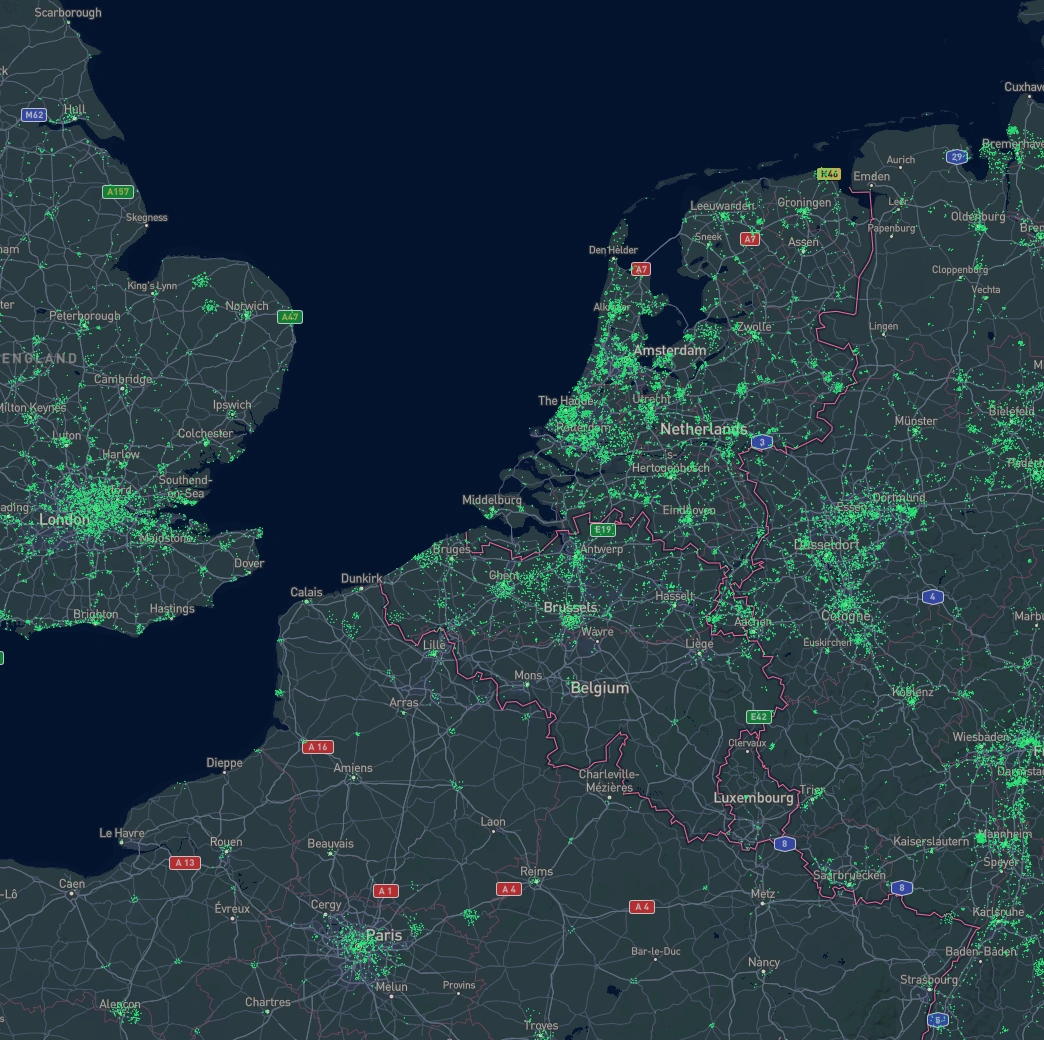
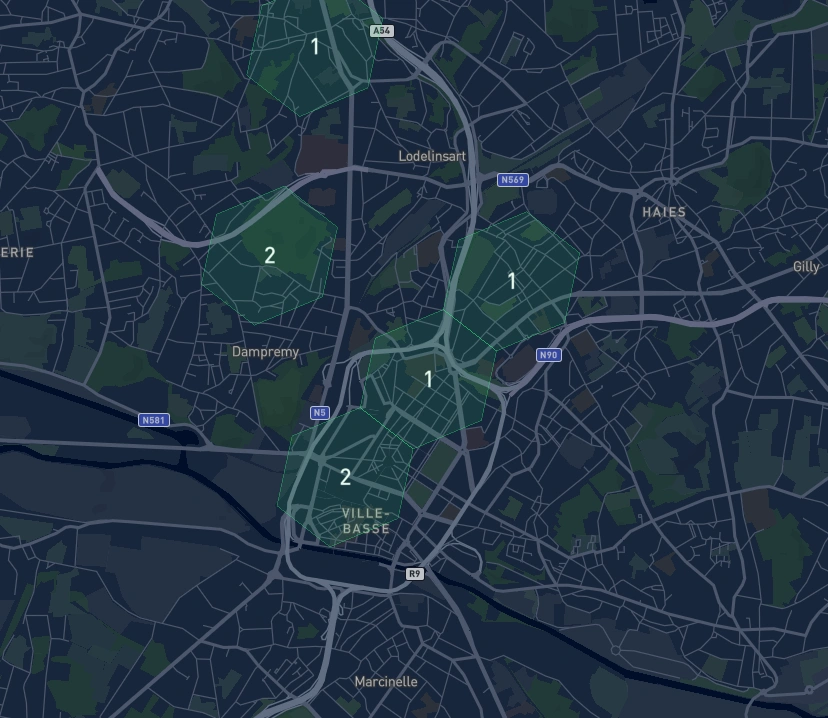
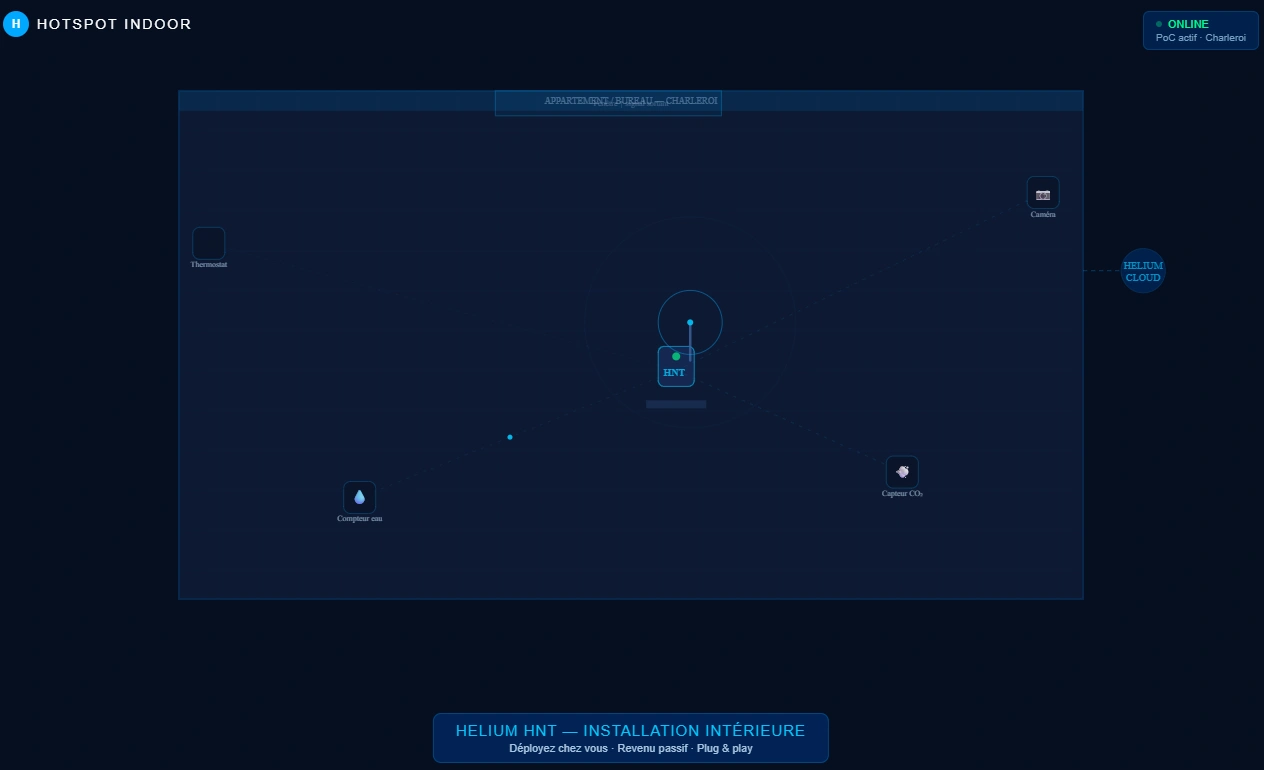
Charleroi, a city in the midst of its digital transformation, is gradually becoming a node of the Helium network in Belgium.
Through hotspots deployed by individuals and local businesses, the city is contributing to a decentralised wireless infrastructure
that connects smart objects (IoT) and provides complementary Wi-Fi coverage alongside the traditional mobile network.
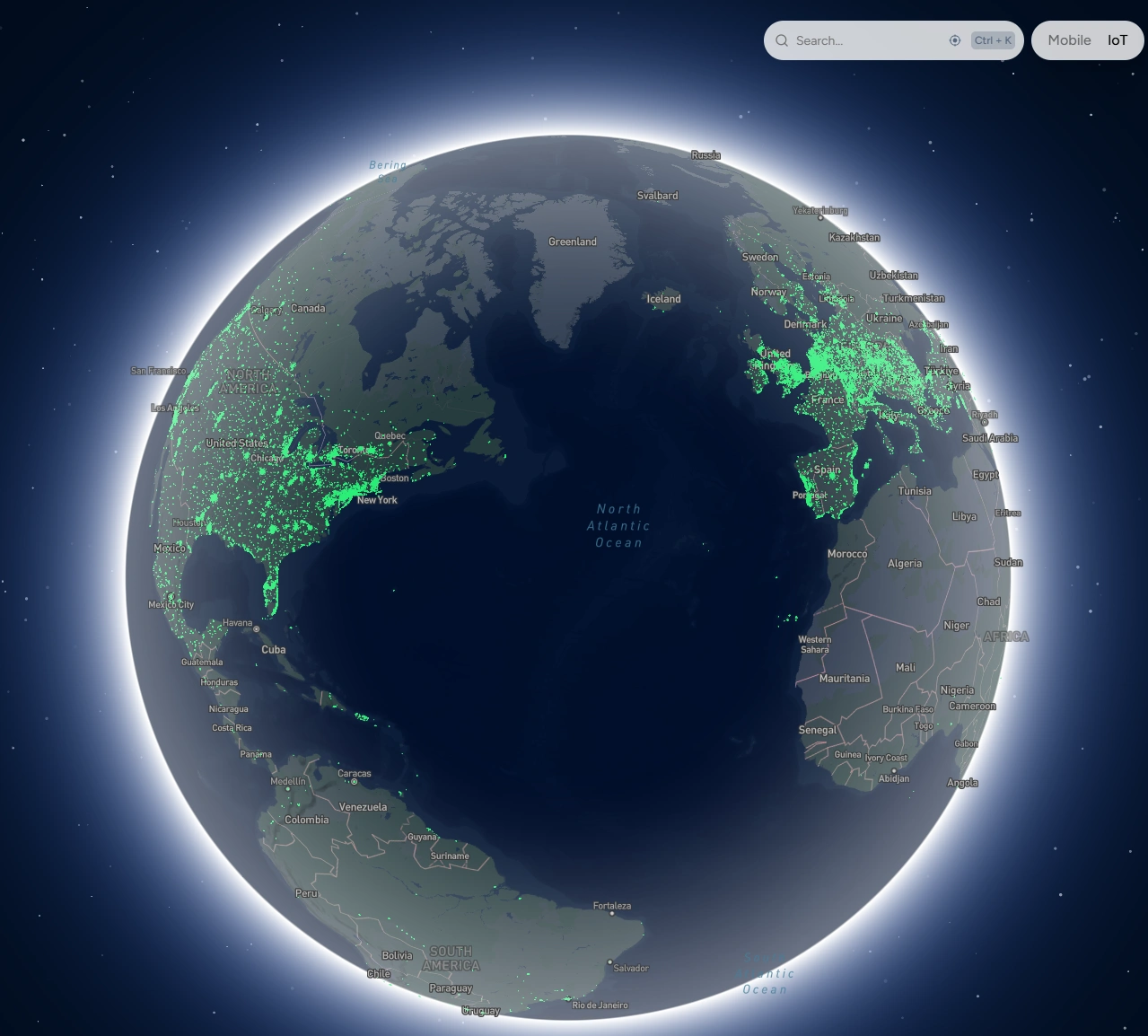
Helium Network World Map: The Helium network is a decentralised wireless infrastructure (DePIN) enabling
anyone to deploy a hotspot at home to provide network coverage for IoT devices and smartphones — and earn $HNT tokens in return.
$HNT Value - Cryptocurrency:
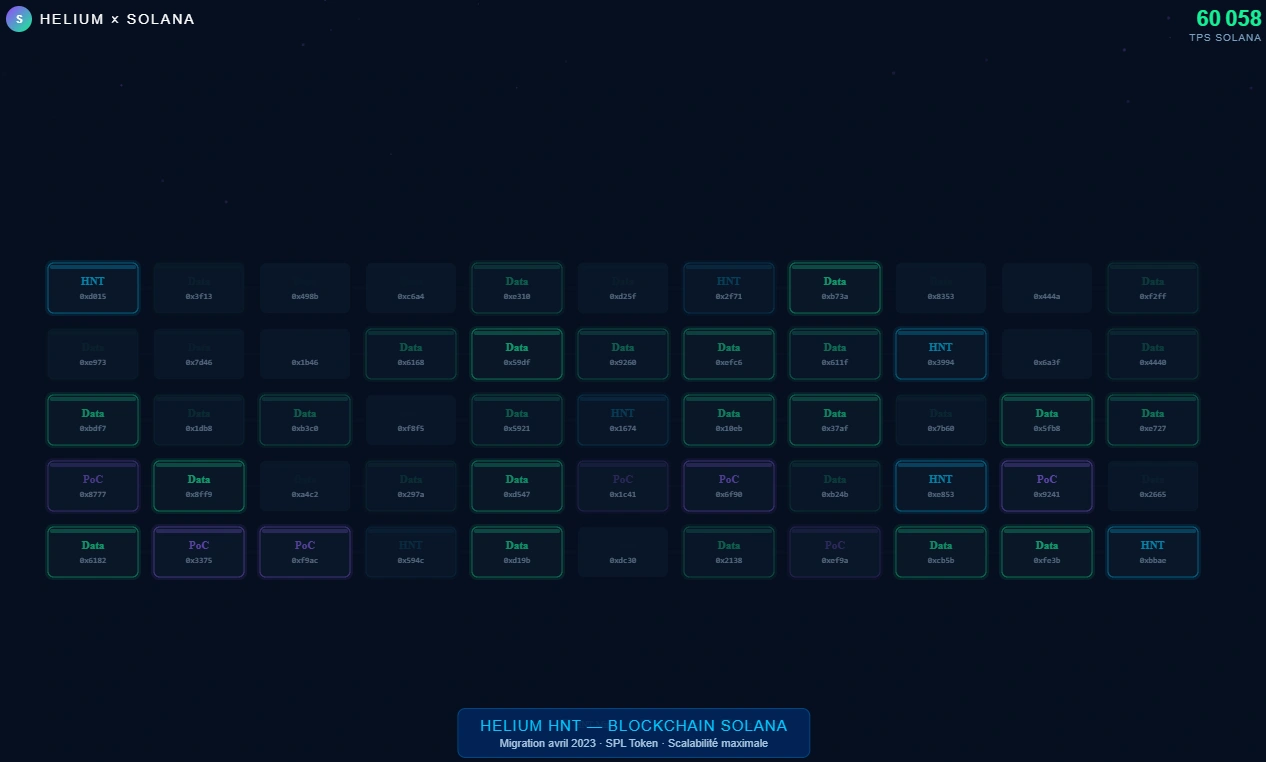
$HNT is the native token of the Helium network, running on the Solana blockchain since April 2023.
It is used to reward hotspot operators, and burned to create Data Credits that allow devices to transmit data over the network.
Join with your own Helium hotspot (IoT or Mobile) and become part of
the global citizen network to enrich the coverage map and contribute to a decentralised wireless infrastructure in your neighbourhood.
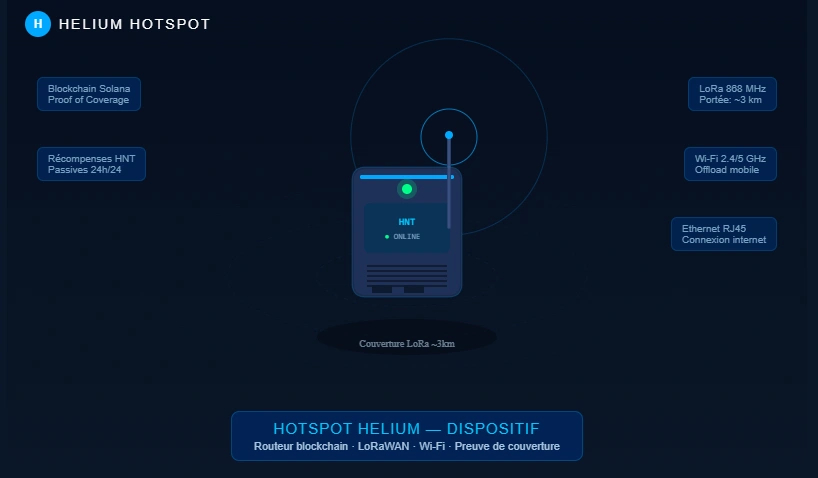
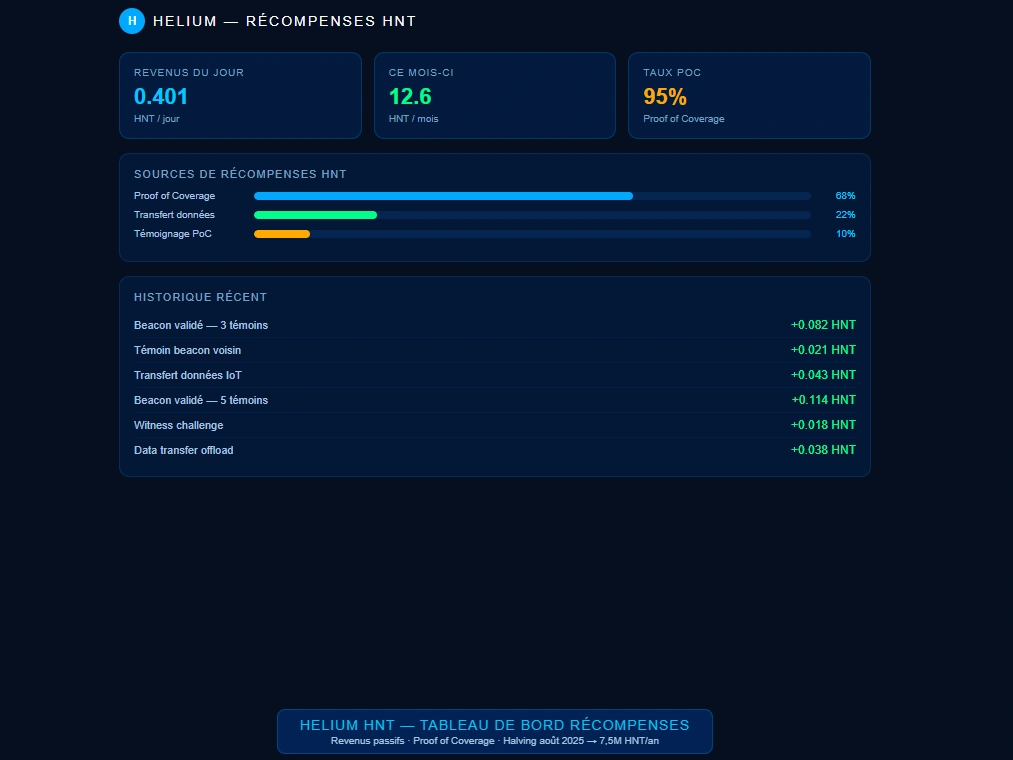
Earn $HNT by installing a hotspot: you can earn $HNT through the Proof of Coverage (PoC) mechanism,
which cryptographically verifies that your device is genuinely providing real radio coverage at its declared location.
These tokens can then be exchanged on specialist platforms or used within the Helium ecosystem.
Proof of Coverage (PoC):
Helium's unique consensus mechanism that verifies the authenticity of radio coverage.
A hotspot receives a challenge, emits a radio signal (beacon), and neighbouring hotspots witness its actual presence.
The more independent witnesses, the more reliable the verification — and the greater the $HNT rewards.
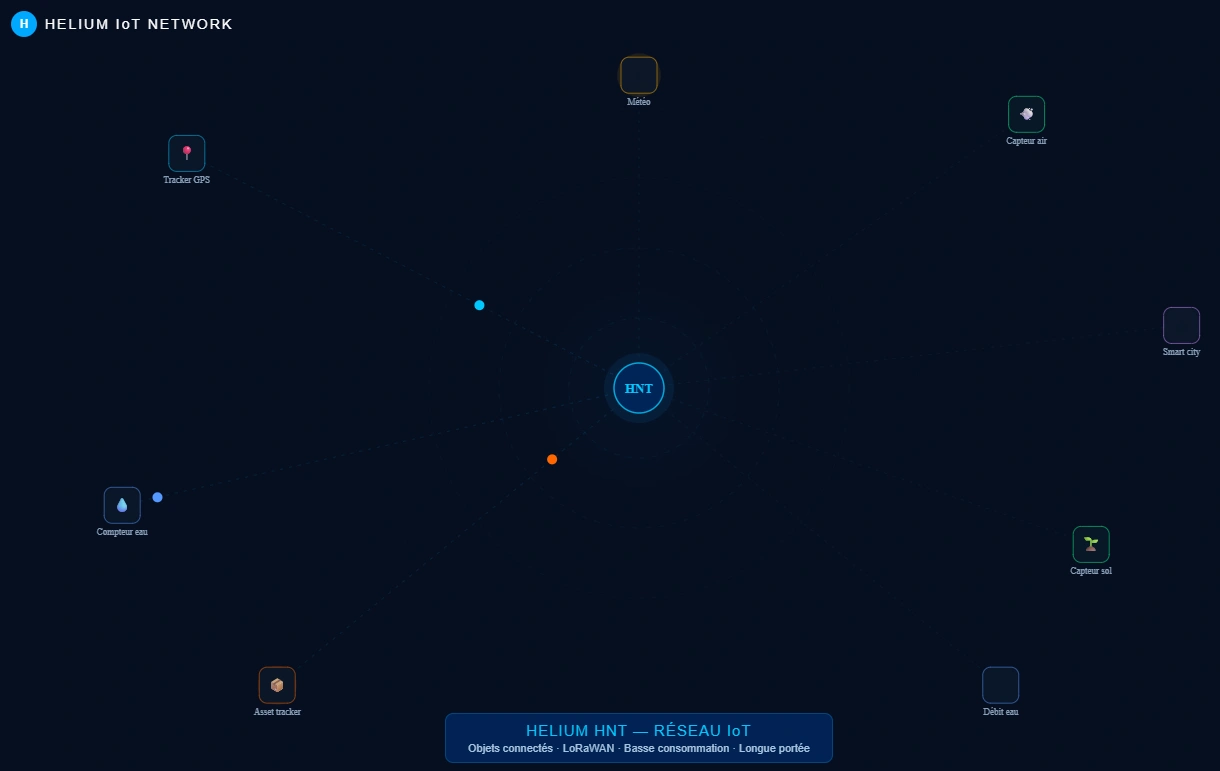
LoRaWAN (long-range IoT):
a low-power, long-range wireless protocol used to connect IoT devices.
A single Helium hotspot can cover several kilometres, enabling environmental sensors,
GPS trackers, smart meters and many other low-power devices to be connected.
Helium Mobile (Wi-Fi offload):
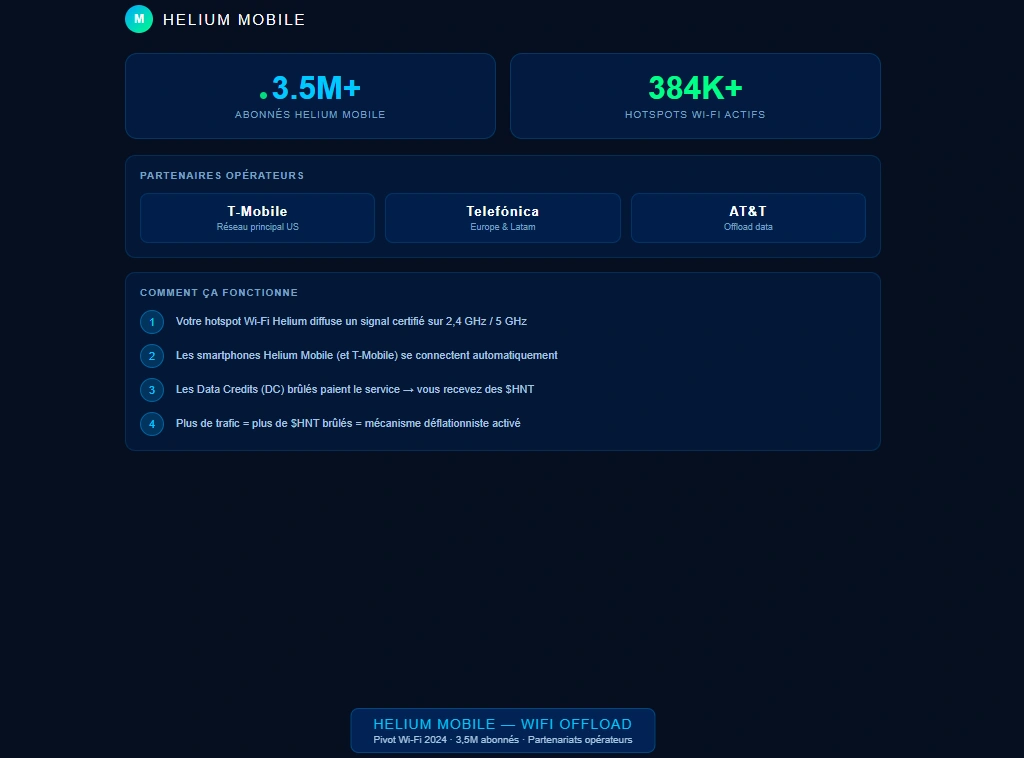
since 2024, the Helium network has shifted towards Wi-Fi hotspots that allow smartphones to offload
their mobile data traffic onto the decentralised network. Helium Mobile has more than 3.5 million subscribers
and works with operators such as T-Mobile and Telefonica.
Data Credits (DC):
a utility token with a fixed USD value ($0.00001), created by burning $HNT.
Each device using the Helium network must spend Data Credits to transmit its data,
creating a deflationary mechanism that ties real network usage to the value of the $HNT token.
To show how the Helium network works in practice, SofieFlat has installed a Milesight LoRaWAN sensor in Charleroi that continuously measures climate conditions.
The battery-powered sensor sends its readings over LoRaWAN radio. They are picked up by nearby Helium hotspots, carried across the decentralised network for a few Data Credits, then displayed on a Datacake dashboard — no SIM card, no Wi-Fi and no telecom subscription.
This live dashboard shows what LoRaWAN makes possible day to day: monitoring the climate, indoor comfort or a building's energy use, at a minimal transmission cost.
Check the Helium coverage map (IoT or Mobile) to identify under-served areas in Charleroi where a hotspot would have the greatest impact and generate the most rewards.
Choose an elevated location with a clear line of sight (rooftop, high window): the LoRaWAN signal range can reach several kilometres in favourable conditions, increasing your chances of witnessing other hotspots.
For businesses and retailers in Charleroi, deploying a Helium hotspot represents an opportunity for passive income while contributing to the local digital infrastructure.
Join the Belgian Helium community to share your experiences, optimise your setup and stay informed about network developments such as the August 2025 halving, which reduced annual issuance to 7.5 million $HNT.
In Charleroi, individuals and businesses install Helium hotspots that provide decentralised IoT coverage (DePIN). In return, they receive $HNT tokens via the Proof of Coverage mechanism on the Solana blockchain.
By installing a Helium hotspot (IoT or Mobile) at your location in Charleroi, you contribute to the global citizen network. The Proof of Coverage (PoC) mechanism cryptographically verifies your radio coverage and rewards you with $HNT tokens exchangeable on specialised platforms.
The $HNT token is the native currency of the Helium network, which has run on the Solana blockchain since April 2023. It rewards hotspot operators and is used to create Data Credits allowing IoT devices to transmit data across the network.
Yes, SofieFlat has installed a Milesight LoRaWAN sensor in Charleroi that measures climate conditions. Its readings travel through Helium hotspots and are displayed live on a Datacake dashboard, with no SIM card or Wi-Fi.