The Quartier du Futur in Charleroi: a new €550 million military barracks
A former steel site reshaping Charleroi's western gateway
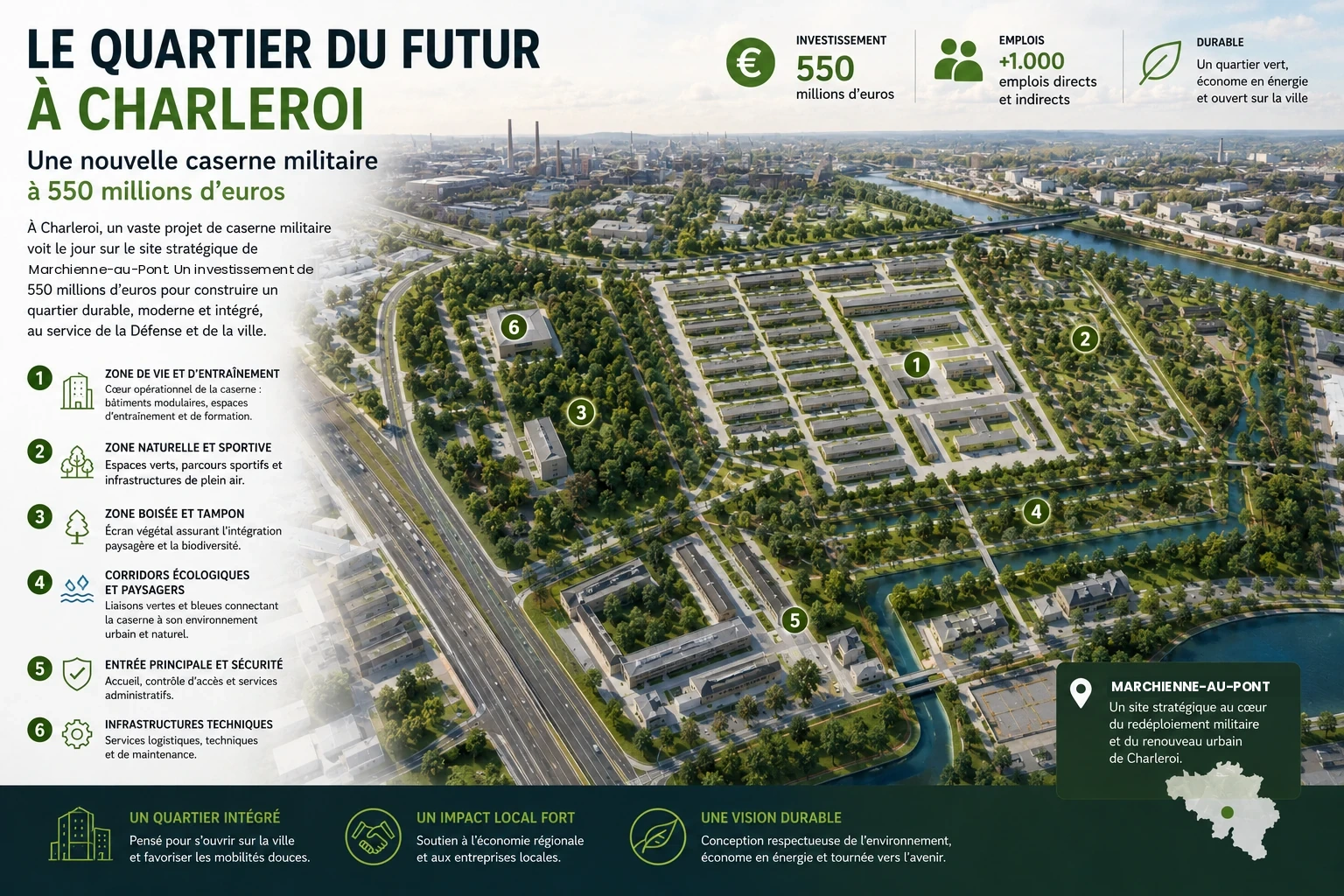
A project shaping the future of the Charleroi region
On 23 July 2021, the Belgian Council of Ministers designated Charleroi as the garrison city for this new
barracks concept known as the "Quartier du Futur". The project is jointly led by the Belgian Defence
department and SORESIC, a structure bringing together Igretec and Wallonie Entreprendre, with support from
Charleroi Bouwmeester on the urban design side. After a masterplan drawn up in 2024 by Archipelago Architects
and several technical partners, and its approval by the city council in early September 2025, soil
decontamination work on the former Duferco/Carsid site began in spring 2026, a necessary first step before
the public design-and-build tender can be launched.
An ambitious investment and timeline —
Defence plans to invest around €550 million, funded at the federal level, in this new-generation
infrastructure. The future barracks will span around 27 hectares, with 19 hectares for the military zone and
5.5 hectares for shared infrastructure with the civilian world, within a wider 100-hectare site being
redeveloped from former industrial land. Construction is set to start in 2028 and last roughly four years,
with the first units moving in around 2032 and a gradual ramp-up continuing through 2035.
Barracks designed to open up to the city —
Unlike traditional barracks, the site will be split into two distinct zones: a secured northern part
reserved for military personnel, facing the Charleroi-Brussels canal, and an open southern part accessible
to residents on foot or by bike from the Mons road. This civilian zone will include a nursery, a primary
healthcare centre, sports facilities, a museum space, food and drink venues, and a covered shooting range
that could potentially be shared with the local police.
Jobs and training —
The project is expected to create around 1,500 military and civilian jobs, combining the transfer of
experienced units with the recruitment of new personnel drawn mainly from the Charleroi area. Defence's
stated goal is to better balance its workforce across Belgian territory, as Hainaut currently has very few
military facilities despite a strong local recruitment potential.
Understanding the project's importance for Charleroi and Wallonia
Why Marchienne-au-Pont?
The choice of site reflects a wider goal of geographic rebalancing: Defence wanted to establish a presence
in a province historically underserved by military infrastructure, while making use of a large-scale
industrial brownfield close to major road and rail links. The former Duferco/Carsid site, on Charleroi's
western gateway, met these criteria while also offering a major economic redevelopment opportunity for the
Marchienne-au-Pont neighbourhood.
Cybersecurity and innovation
The Quartier du Futur builds on the Cyber Defense Factory, established in Charleroi in 2024 as the
cybercommand's first civilian foothold. Its proximity to the A6K/E6K technology hubs is meant to connect the
future military district to the local training and innovation ecosystem in cybersecurity, helping attract
specialised talent.
Mobility and regional connections
The site's close proximity to the Charleroi-Brussels railway line, which runs about 150 metres away, has
opened discussions about doubling that line as part of a mixed civilian-military use, with possible support
from European funding. Better rail service would benefit everyone travelling between Charleroi and the
capital.
A symbol for a city born military
The arrival of this new barracks echoes Charleroi's own history: the city was founded in 1666 as a
fortress town under the name Charle Roy. Nearly four centuries later, Charleroi is reconnecting with its
military origins, as part of a broader redevelopment movement alongside other major urban projects led by
Charleroi Bouwmeester and the City.